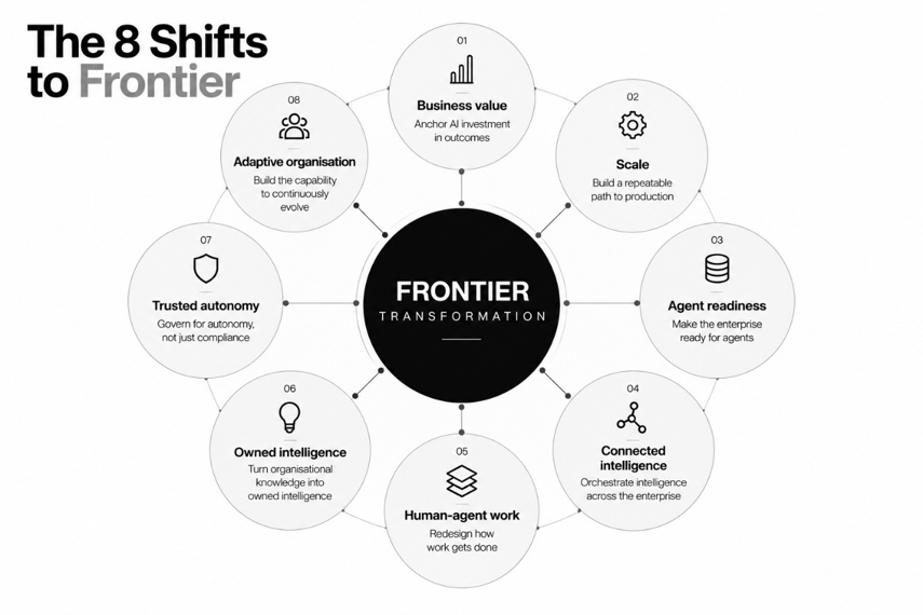
Build the capability to continuously evolve
FROM AI PROJECTS → TO AN ADAPTIVE ORGANISATION
The first seven shifts will not sustain themselves without an organisation designed to support them. That means clear executive ownership, cross-functional decisions, funding, skills and incentives that move AI beyond individual projects. Business, technology, data and security teams need to connect continuously, not only when a project requires them.
Microsoft’s 2026 Work Trend Index found organisational factors were more strongly associated with self-reported AI impact than individual factors. These survey findings do not establish causation, but they reinforce the importance of the organisation around the technology. [2]
There is no permanent state of AI readiness. Models will improve. Agents will become more capable. Today’s frontier will become tomorrow’s baseline. The enduring capability is not becoming ready for today’s AI. It is building an organisation that gets better every time AI does.
Start with one valuable workflow. Establish a baseline, appoint an accountable owner and define autonomy boundaries. Measure outcomes, costs and risks before expanding. Use what you learn to revisit value, feasibility and readiness, then take the next step.
The organisations that succeed will not necessarily be those that adopt AI fastest. They will be those that learn fastest. Every new model, agent and capability creates new opportunities and new constraints. The path to Frontier will look different for every organisation, but the destination is an enterprise capable of continuously turning what AI makes possible into sustained business value.
Sources
[1] Microsoft. 2025 Work Trend Index: The year the Frontier Firm is born. https://www.microsoft.com/en-us/worklab/work-trend-index/2025-the-year-the-frontier-firm-is-born
[2] Microsoft. Agents, human agency, and the opportunity for every organisation. 5 May 2026. https://www.microsoft.com/en-us/worklab/work-trend-index/agents-human-agency-and-the-opportunity-for-every-organisation
[3] Pereira, Graylin and Brynjolfsson. The Enterprise AI Playbook: Lessons from 51 Successful Deployments. Stanford Digital Economy Lab, April 2026. https://digitaleconomy.stanford.edu/app/uploads/2026/03/EnterpriseAIPlaybook_PereiraGraylinBrynjolfsson.pdf
[4] ASD Australian Cyber Security Centre. Careful adoption of agentic AI services. 1 May 2026. https://www.cyber.gov.au/business-government/secure-design/artificial-intelligence/careful-adoption-of-agentic-ai-services
[5] Brynjolfsson, Li and Raymond. Generative AI at Work. Quarterly Journal of Economics 140(2), 2025, pp. 889–942. https://academic.oup.com/qje/article/140/2/889/7990658
[6] National AI Centre. Guidance for AI adoption: implementation guidance. 5 May 2026. https://www.ai.gov.au/staying-safe-and-responsible/essential-ai-practises/guidance-ai-adoption-implementation-guidance