

Connect with our experts
Share a few details about your business challenge, and we’ll get right back to you.
Connect with our experts
Share a few details about your business challenge, and we’ll get right back to you.

COPILOT INSIGHT SERIES #3
Generative AI like Microsoft Copilot offer powerful transformative potential to businesses. The underpinning cloud infrastructures and integrations required to harness Gen AI is also driving a new boom cycle for IT services. Yet, one of the greatest barriers to AI adoption and success for implementations is risk, and much of this is around the use of data.
Data is the fuel that powers every AI, and this fuel is highly combustible! It needs to be stored, managed and accessed the right way by those developing and training AIs, and those using AI tools like Copilot. When it is not, businesses are at increased risk of catching regulatory, financial and reputational fire.
For partners, there is a considerable opportunity to respond to the many ‘data readiness’ requirements that underpin safe, secure and successful use of Copilot.
In the video and article below, I’ll go into some further detail.

AI’s value comes from accessing corporate information — documents, CRM data, emails, and more. Depending on the nature of the business, data stores that may need to be accessible by AI could include customer/consumer information.
Generative AI tools like Copilot don’t “know” anything by default — they learn from, and work with, the data they can access in an organisation’s environment. That means:
There is a raft of considerations to be factored in around how data is classified, secured, managed and accessed before it is ingested by an AI. Well-considered and defined governance frameworks reduce the risk of unintended and sometimes damaging outcomes.
Data readiness isn’t about how much data you have — it’s about:
Businesses are rightly concerned about the risk posed if AI tools:
SoftwareOne's own recent study into SMB operations across the APAC region shows SMBs
These findings correlate closely with our own data, shown below and reinforces the importance of addressing data and information management risk early.
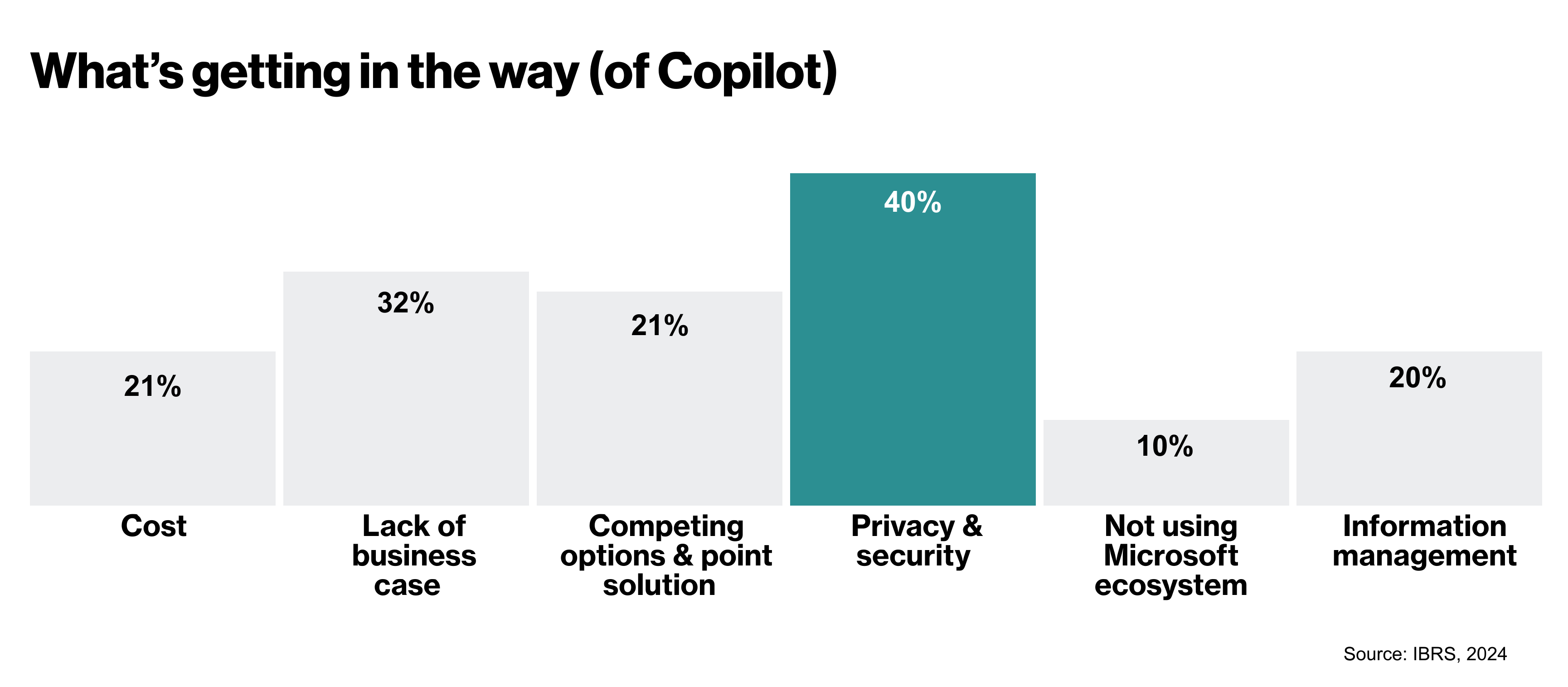
Real-world examples I have personally seen occur include:
Without clear data governance, these risks become business-critical issues.
Risk management isn’t just about data classification — it’s also about compliance, ethics, and responsible AI use. How AI use aligns with organisational values and regulatory/compliance requirements is an important topic to canvass, whether you’re working with a small business owner or a board.
Helping clients frame AI policies, design ethical guidelines, and create compliance guardrails will become core parts of every AI engagement.
The growth potential for partners goes so much further than selling Copilot licenses. AI adoption is a journey of digital uplift that intersects with cloud infrastructure, cybersecurity, continuity, digital workplace systems and business applications.
However, the starting point is always data.
For customers to achieve sustained value from Copilot, they’ll need a data readiness roadmap. You don’t need deep AI expertise to deliver value here. Start with what you know and extend it. If you have solid capabilities in backup, or security or M365 management, consider using Microsoft Purview to classify and govern data access or applying Microsoft Defender to secure data pathways.
The table below outlines seven key readiness steps, aligned to potential service opportunities and vendor/tool options. This is a practical framework for engaging customers through what’s needed to get their data house in order, ahead of AI adoption.
| Step | Description | Service Opportunity | Tools & Vendors |
|---|---|---|---|
| 1. Data Inventory & Mapping | Identify all data sources, storage locations, and access rights. | Data discovery audits, duplicate detection, shadow IT identification. | Microsoft 365, SharePoint, OneDrive, AvePoint |
| 2. Access Controls | Apply role-based permissions to prevent unauthorised AI data access. | Permissions audits, role configuration, MFA and identity integration. | Microsoft Defender for Identity, Azure AD, CoreView |
| 3. Data Classification & Labelling | Tag data by sensitivity, compliance requirements, and business relevance. | Automated classification rules, retention policy setup. | Microsoft Purview, AvePoint, Netwrix |
| 4. Retention Policies & Clean-Up | Remove outdated, irrelevant, or non-compliant data from active use. | Data lifecycle management, archival solutions, deletion workflows. | Microsoft Purview, Wasabi, Veeam |
| 5. Secure Storage & Encryption | Ensure all AI-accessible data is stored securely and in compliance. | Cloud or hybrid secure storage, encryption configuration. | Azure Storage, Wasabi, Acronis |
| 6. Copilot Security & Compliance Config | Limit AI scope to authorised data and enable compliance monitoring. | Copilot scope setup, compliance dashboards, usage alerts. | Microsoft 365 Copilot admin, Purview compliance center |
| 7. Ongoing Monitoring & Optimisation | Continuously review data access patterns and AI usage quality. | Quarterly reviews, optimisation reports, policy adjustments. | Fabric, Power BI, CoreView |
Getting the data foundations in place for sustained success with Copilot will take time and investment for your clients. Some will bridle at this and look to you for silver bullets that provide shortcuts through this stage of the AI adoption journey.
They’ll only end up shooting themselves in the foot.
By starting with data readiness, you’ll be guiding your customers to
In the next chapter of our Copilot Insight Series, I’ll offer some thoughts on successful pilot projects, which will further highlight the importance of getting solid data foundations in place.
AI Pilot Projects.
Share a few details about your business challenge, and we’ll get right back to you.
Share a few details about your business challenge, and we’ll get right back to you.

